

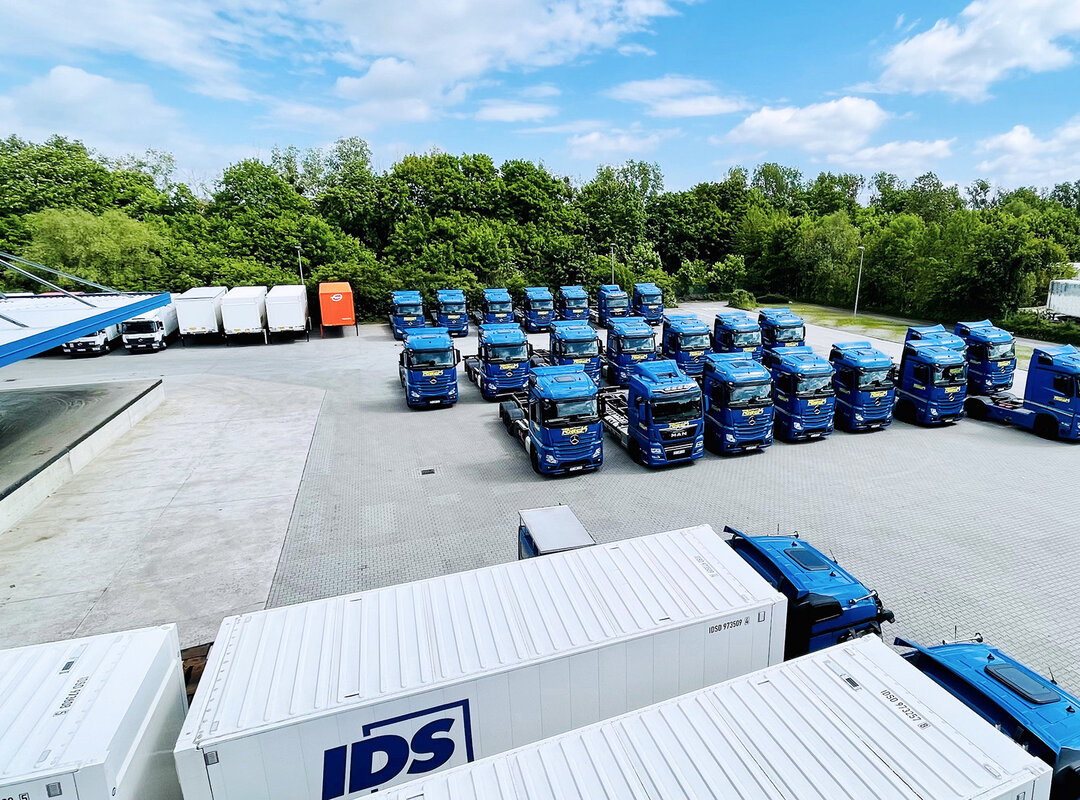
Community connects and commits. The entire logistics industry is facing the key challenge of making operational processes even more sustainable and actively contributing to reducing its ecological footprint. What sounds like a mammoth task is actually one: How can we as the Rieck Logistics Group achieve the major goal of “net zero emissions” and become climate neutral? It is clear that if we want to make optimum use of all the resources available to us, we must also take responsibility for our environment. The good thing is that we are not alone in this: as one of the seven partners in the IDS network, we are in direct contact with the other cooperation partners. Here, everyone learns from each other in order to break down the complex logistics processes and make them “greener” in the future.
"Transport and handling emissions from IDS shipments account for at least 95% of overall emissions and therefore the network footprint. We have to act here."
Philipp Strenge, Geschäftsführender Gesellschafter Rieck Logistik-Gruppe
As part of the cross-partner “IDS Green Logistics” project, all IDS members came together at the end of last year to define binding fields of action and set emission reduction targets. The result: by 2050, the entire IDS network with all partners and 54 depots should be completely climate-neutral. To calculate greenhouse gases, not only CO2 (carbon dioxide) but also all CO2e equivalents (carbon dioxide, methane, nitrous oxide, etc.) are taken into account.
The journey is the destination
Despite all the efforts, the “net zero emissions” mission cannot be achieved all at once, but only gradually. “Within the IDS network, we have agreed on reduction targets with all members. The aim is to reduce emissions per tonne-kilometre by 21% by 2030 and 60% by 2040 compared to the base year 2023,” says Dr Michael Bargl, Managing Director of IDS Logistik GmbH. Progress and the current status of target achievement are monitored in regular project meetings and sustainability reports and corrected if necessary.
- By 2030: - 21 %
- By 2040: - 60 %
- By 2050: Climate neutral
Rieck is already doing this today
The urgency of curbing climate change requires companies to comprehensively review their business practices. At Rieck, we began this process years ago and set up a cross-divisional project team specifically for the topic of “quality and sustainability”. We also started an energy audit in accordance with DIN EN 16247-1 back in 2015 to get a clear picture of possible improvements to save CO2.
Three sites have now been upgraded with photovoltaic systems. We use around a quarter of the electricity produced to supply the logistics facilities, while the rest is fed into the power grid. This allows us to save several thousand tons of CO2 every year. Further locations will follow. We also rely on a green electricity mix for the electricity we draw from the grid at our other branches. This produces around 14 tons less CO2 per month than electricity from fossil energy sources.
The first BEV truck (“Battery Electric Vehicle”) is in use in Berlin and more are planned. In addition to intelligent route planning, the entire truck fleet was converted to Euro6 vehicles 10 years ago, the company car fleet for Rieck employees was partially converted to hybrid vehicles and is powered by its own charging infrastructure. Always in view: The development of biofuels, such as “Hydrotreated Vegetable Oils” (HVO).
We also regularly re-evaluate our supply chain cooperation. “Cooperation with our suppliers, partners and service providers is crucial. Joint efforts to reduce emissions along the entire supply chain can lead to sustainable change,” says Philipp Strenge.
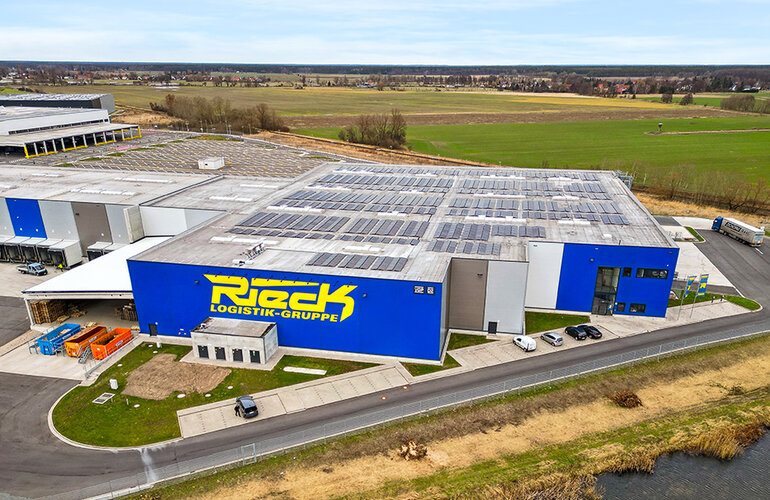
Green operation in Berlin-Nord: Green electricity is produced via a solar roof and used to power the terminal and the fleet.
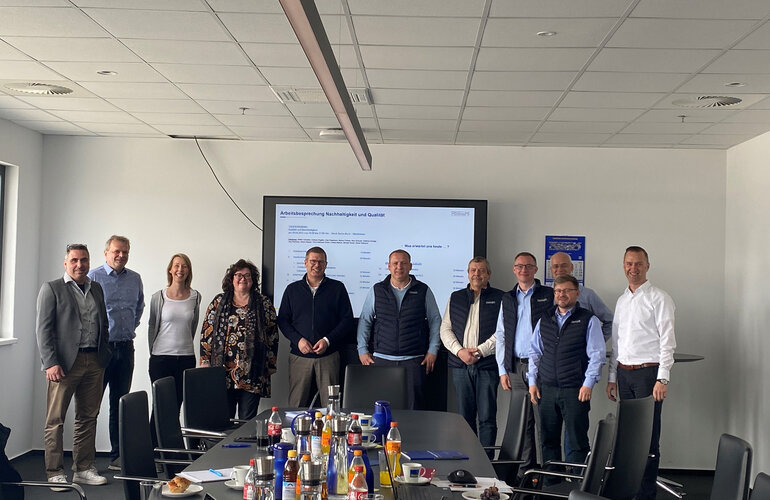
Quality and sustainability” project team Representatives from all Rieck divisions regularly exchange ideas to advance the “green revolution”.