

20 years of the IDS central hub
The backbone of the general cargo network
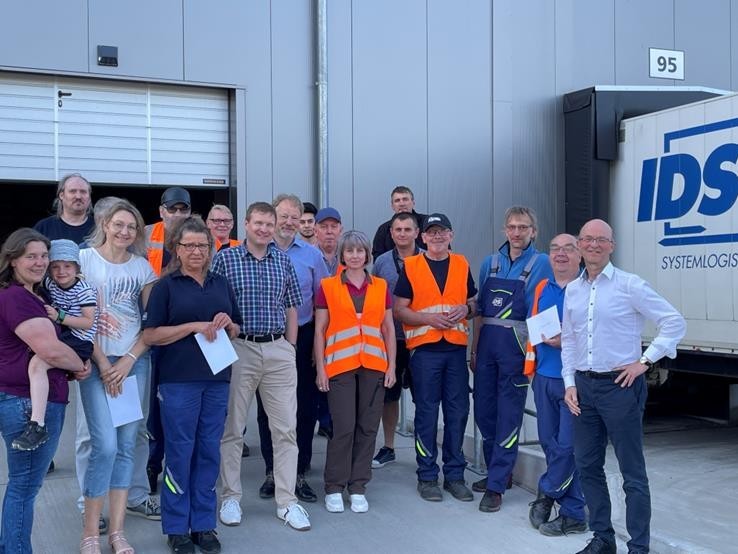
Kleinostheim/Neuenstein, June 19, 2023 – 20 years ago, IDS Logistik GmbH opened the IDS central HUB in Neuenstein near Bad Hersfeld as the backbone of its general cargo network. As an important pillar of the IDS transport security concept, it ensures the consistently high quality of transport services in the IDS network.
IDS Logistik is currently celebrating the 20th anniversary of its central HUB in Neuenstein near Bad Hersfeld in Hesse. The IDS HUB was launched in 2003 with 280 tons of overnight handling; today it handles an average of 800 tons and over 1,200 tons at peak times.
In the geographical center of Germany, conveniently located on the A7/A4 motorway, around 70 employees handle around 3,500 shipments every night at the IDS central hub. The trucks from the current 54 IDS depots meet here and exchange their consignments within a few hours, ensuring that the desired goods arrive from Rosenheim to Rostock within 24 hours.
More space for growth
In order to have sufficient space for further growth and additional HUB transports from other IDS depots, the central HUB hall was expanded by 3,000 m² and 23 new gates in 2019. Today, 8,200 square meters of handling space and 105 gates offer sufficient capacity for the further expansion of the general cargo network.
In addition to economic efficiency and process optimization, sustainability was also on the agenda for the expansion of the IDS central hub. 1,000 solar modules with a total output of 300 KW were installed on the roof of the extension. In addition to the hall and the office building, the photovoltaic system also supplies solar power to the 21 forklift trucks and 5 high-speed trucks that handle the 3,500 consignments at the Neuenstein central hub every night.
On sunny days, the system generates around two megawatt hours of electricity per day. The self-consumption rate is then around 63 percent, with the surplus electricity being fed into the grid. In order to be able to use as much of the self-generated solar power as possible at night, a battery storage unit with a capacity of 50 KWh is also used.
IDS is currently working on a concept to make the hub traffic largely CO2-neutral over the next decade.
The IDS transportation network
54 IDS depots ensure a nationwide general cargo network in Germany. Around 90 percent of transports are covered by direct transports between the individual depots, i.e. between the dispatch depot and the receiving depot. This means that a truck drives from depot A to depot B. On the return journey, it transports the consignments from depot B to depot A and vice versa. But what happens when
- the liner truck is full and the shipments can’t wait a day,
- the shipping depot has too many volumes and not all trucks with customer shipments can be unloaded or transshipped,
- the 24-hour service cannot be maintained on very long distances, e.g. from Rosenheim to Rostock, or
- shipping depots with lower volumes do not have enough volume to drive to the other depots for the 24-hour express service?
The relapse solution
This is where the IDS central HUB in Neuenstein comes into play. It serves as an important pillar of the IDS transport security concept in order to maintain the quality of transport services at a consistently high level. This is more important than ever, especially in times of strongly fluctuating shipment volumes with high volume peaks.
Around 80 truck trains are now unloaded at the IDS central hub every night between 9 p.m. and 1 a.m. – timed to the minute – and loaded again by 3 a.m. at the latest. This is because the trucks have to arrive at the receiving depot by 6 a.m., or 7 a.m. at the latest, so that their consignments can be loaded onto the local trucks in time for delivery. Night after night, around 5,500 colli are handled in Neuenstein. At peak times, for example during the spring and Christmas business, there can be over 90 trucks with 6,500 colli.