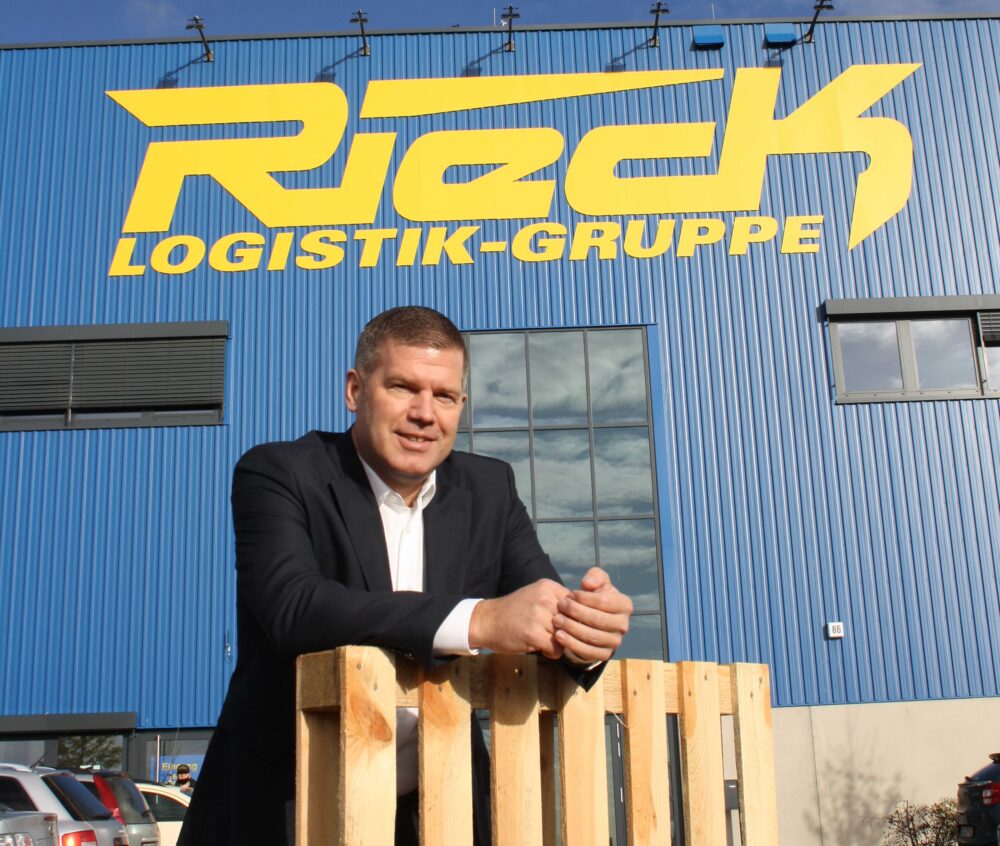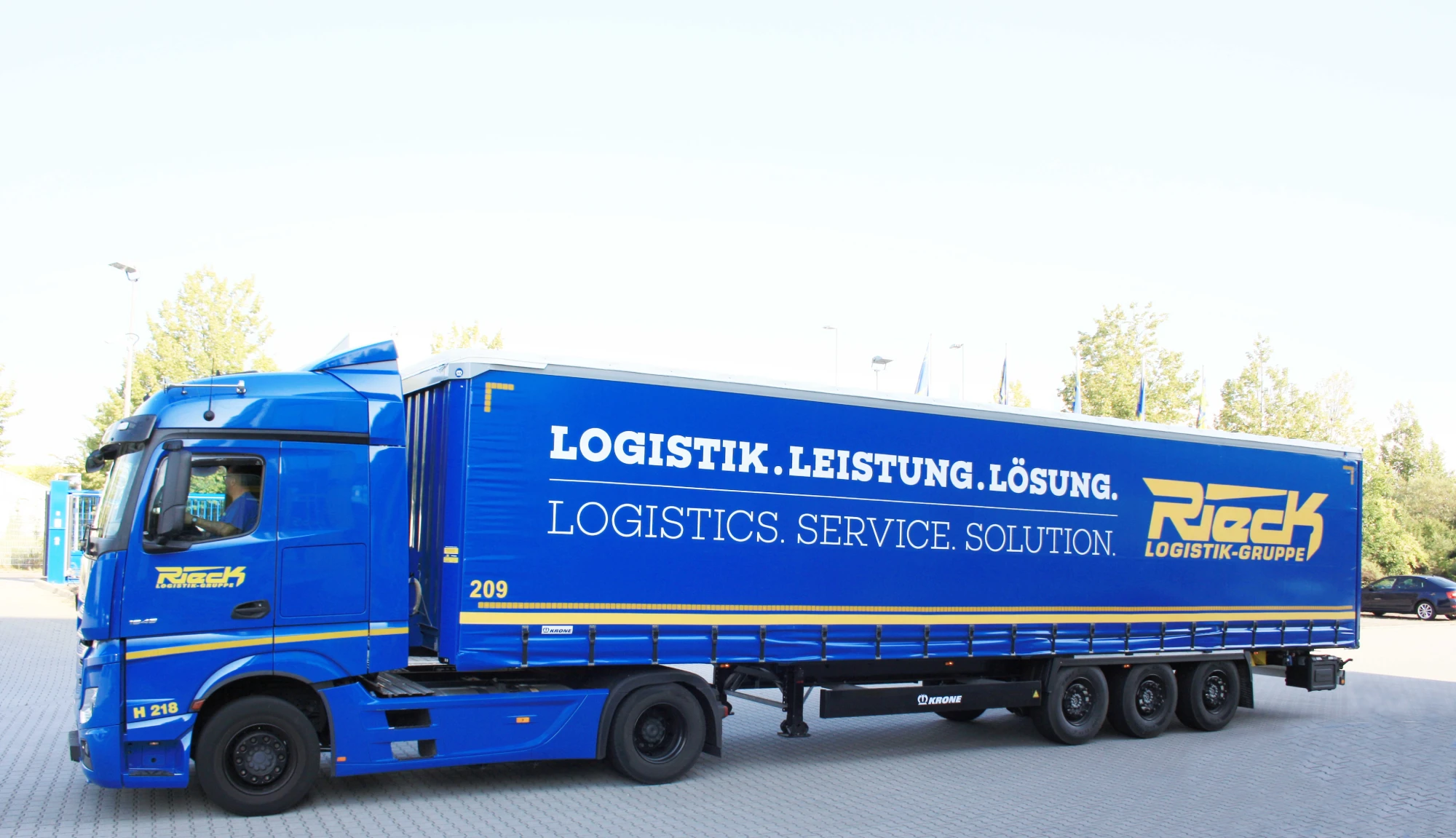


Philipp Strenge has been one of the managing partners of the Rieck Logistics Group, based in Großbeeren near Berlin, for almost 10 years. Together with his co-partners Hartmut Rieck and Stefan Rieck, he is the fourth generation to manage the Rieck Logistics Group. Together they are expanding traditional and stable structures at new and modern locations with a view to the future.
Mr. Strenge, Rieck moved from Berlin to Brandenburg almost 20 years ago. Why was this a landmark move?
The relocation of the Rieck headquarters from central Berlin to the Großbeeren freight village south of Berlin in 2002 was both the basis and the starting signal for more diversification and growth in the group of companies. We wanted to position ourselves more broadly and offer the complete portfolio of a logistics company. From here, Rieck Holding, as the umbrella organization of the group of companies, manages the strategic orientation, financing and central staff departments such as key account management, marketing, sales, insurance, legal and human resources. Rieck Consulting Services, also based in Großbeeren, is responsible for IT, accounting and controlling for the Rieck Logistics Group.
And the operational business areas?
The System Forwarding, Sea Air Cargo, Fulfillment Solutions and Disposal Logistics operating divisions are at the heart of the Group. They are organized in legally independent companies. Visions and strategies are developed together with the holding company and shaped locally by managing directors and their teams.
You have now been in management for almost 10 years …
… and have been working for our company for 13 years, since 2007. I still remember very well how I went to work with my mother Hannelore Strenge, née Rieck, as a little boy, completed an internship at the traditional “Green Week” in Berlin as a schoolboy, worked as a student trainee at German Parcel (now GLS) in the handling hall, completed a trainee apprenticeship in Hamburg and then went on to complete my business studies at the FU Berlin. So I was well trained to start at Rieck and gradually familiarized myself with the various business processes with the help of the other partners and my uncle Ulrich Rieck, who passed away in 2012.
Rieck is primarily active in the new federal states. Why is your focus there in particular?
Rieck is an IDS franchisee in Mecklenburg-Western Pomerania, Berlin, Brandenburg and parts of Saxony with its system forwarding division. Our regional ties to the new federal states have grown with our involvement in IDS. After reunification, our freight forwarding activities were expanded from our then headquarters in the heart of Berlin to the Dresden region and then transferred to Mecklenburg-Western Pomerania due to the positive developments there. But Rieck also has a decades-long tradition in the old federal states. For example, we are based in Hamburg with sea freight and contract logistics and in Neuss with waste disposal logistics. Air freight activities are carried out in Frankfurt, Berlin and Munich. Our office in Shanghai is the furthest away. Global air and sea transportation is managed from here.
How can we imagine the expansion to Dresden?
In Dresden, we took over Kraftverkehr Dresden in the Elbe harbor in 1992. The hall there quickly became too small, so we opened the current IDS Depot 0100 in Ottendorf-Okrilla in 1995. It was expanded under the motto: “There’s always something going on at Rieck”. Today, we have a total of 18,000 square meters of space and 65 employees here. A further expansion is currently in the early planning phase.
And how long have you been active in Rostock?
The first stake in HOMTRANS was acquired in 2012. The company has been wholly owned by the Rieck Logistics Group since 2015. Founded as one of the first GmbHs in Rostock after reunification, HOMTRANS celebrated its 30th birthday this year. The company is characterized by its long Hanseatic success story. The commitment in Rostock has paid off. HOMTRANS has managed to almost double its turnover between 2012 and today and is the Group’s largest own location in terms of space. Contract logistics and freight forwarding share the site. Logistics experts for spare parts for wind turbines and production supply for the automotive industry make the site particularly strong today.
What does the establishment of Tesla in Brandenburg mean for Berlin in general and for Rieck in particular?
For Berlin-Brandenburg, the decision to locate Tesla’s Gigafactory in Grünheide is a clear commitment to internationality and cosmopolitanism. It is a breath of fresh air for the economy and the labor market. Where industry settles, service providers, such as logistics companies, also follow. We have been working in Grünheide for the world market leader in braking systems for over a year now. So this is nothing new in the new federal states. At HOMTRANS, too, Rieck has already seen how the arrival of the automotive industry has contributed to growth.
Nothing works today without digitalization. Where do you currently stand and where do you want to go?
IT is a top priority at Rieck. Over the past 40 years, Hartmut Rieck has developed Rieck IT into the company’s core competence. Every year, we invest 2.5 to 4 million euros in technical innovations, a large part of which is invested in IT, data center performance and IT security, but also in developing tailor-made software solutions for customer projects. The newly created position of Chief Digital Officer (CDO) will act as a link between operational requirements and technology to drive IT developments forward. Business intelligence, e-forwarding tools, semi-automated tour scheduling and scanner-supported hall and loading processes are at the top of the agenda alongside the operation of the central data center and IT security.
What impact has coronavirus had on your company?
Corona has affected our business divisions in very different ways. This ranges from short-time working and slumps in air freight to record shipment volumes due to a multiplication of online orders in the B2C segment. We had to postpone some projects until next year. Nevertheless, we are confident that processes will return to normal in 2021 and that aircraft will be allowed to take off again
Sea freight only came to a standstill for a short time. The initial closure of the retail sector was a challenge because no goods were called off, but new goods were still arriving at the ports. We had to rent additional storage space for this. The Rieck Group is so solid that it will get through this crisis without any damage – a good signal for our customers and employees, who can rely on us. The coronavirus pandemic has once again highlighted the systemic importance of the logistics sector in recent months.
Rieck has been an IDS partner since 1989. What does that mean for you?
IDS has made a significant contribution to the development of the Rieck Group in the system forwarding segment. As Deputy Chairman of the Advisory Board, it is my personal goal and concern to continue the future development of IDS
, taking into account the interests of all shareholders.
Mr. Strenge, thank you very much for the interview!